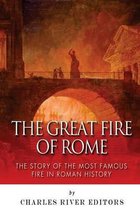
The Great Fire of Rome L' Story de l'incendie le Most célèbre de l'histoire romaine
Auteur:
enBroché978150108143907 septembre 201440 pages
Résumé
*Includes pictures*Includes ancient accounts about Nero and the Great Fire*Includes a bibliography for further reading*Includes a table of contents“A disaster followed, whether accidental or treacherously contrived by the emperor, is uncertain, as authors have given both accounts, worse, however, and more dreadful than any which have ever happened to this city by the violence of fire. It had its beginning in that part of the circus which adjoins the Palatine and Caelian hills, where, amid the shops containing inflammable wares, the conflagration both broke out and instantly became so fierce and so rapid from the wind that it seized in its grasp the entire length of the circus.”Among all the natural disasters that struck Rome, one of the most well-known is the Great Fire of Rome, in part due to the popular myth that Emperor Nero fiddled while the Eternal City burned, even though no fiddle existed in 1st century Rome. Suetonius and Cassius Dio, two of Nero’s ancient biographers, are adamant that it was he himself who set the fire (or ordered it set), and they are the originators of the myth that Nero played the lyre, danced around his palace and sang “The Sack of Troy” while Rome burned outside his windows.Even though those accounts are likely apocryphal, it is true that on the night of July 18th, 64 A.D., the most significant event of Nero’s time in power – and the one which, for better or for worse, would seal his name in infamy throughout the ages – took place. What became known as the Great Fire of Rome started sometime between the night of the 18th and the earliest hours of the 19th, and it consumed almost a quarter of the city as it burned out of control for five days. Interestingly, though there is archaeological evidence for the fact that the fire actually took place, and its extent was as significant as the sources seem to indicate, Tacitus is the only one who gives a comprehensive account of the fire, with other biographers not even mentioning it (aside from Pliny, who mentions it in connection to another incident). It is most likely that the fire was an accident, likely caused by flammable materials near the Circus Maximus. Indeed, blazes of such kind were common until the 19th century in overcrowded cities with wooden houses closely packed together, lit and heated by open flames, and with no organized official fire brigades. In fact, Rome would suffer two more major fires in the next 15 years. Regardless of its origins, the fire was a disaster for Rome. Though casualties are unknown, it destroyed scores, if not hundreds, of private residences, commercial premises, and public buildings. According to Tacitus, Nero quickly hurried back from Antium when news reached him of the fire and opened the doors of his palace to common people dispossessed by the flames. Tacitus claim Nero also spent days, sometimes without his bodyguards, combing the smoking ruins for victims and partially funding the relief effort out of his own private fortune. Though this is partially at odds with Nero’s perceived character, his populist generosity to the lower classes, which was a hallmark of his reign, was in keeping with his previous legislation and sounds like it could have a kernel of truth. Either way, the Great Fire of Rome permanently tarnished Nero’s reign, and it ultimately helped bring about the downfall that ended with the Roman emperor committing suicide just a few years later in 68 A.D. The Great Fire of Rome chronicles the most famous fire to strike the Roman Empire, and the important aftermath of the damage it caused.
Spécifications produit
Contenu
- Langue
- en
- Version
- Broché
- Date de sortie initiale
- 07 septembre 2014
- Nombre de pages
- 40
- Illustrations
- Non
Personnes impliquées
- Auteur principal
- Editeur principal
Autres spécifications
- Hauteur de l'emballage
- 2 mm
- Hauteur du produit
- 2 mm
- Largeur d'emballage
- 152 mm
- Largeur du produit
- 152 mm
- Livre d‘étude
- Oui
- Longueur d'emballage
- 229 mm
- Longueur du produit
- 229 mm
- Poids de l'emballage
- 68 g
- Police de caractères extra large
- Non
EAN
- EAN
- 9781501081439
Sécurité des produits
L'opérateur économique responsable dans l'UE veille au respect des obligations en matière de sécurité des produits.
Vous trouverez cet article :
- Catégories
- Livre, ebook ou livre audio ?
- Disponibilité
- Langue
- Type de livre
Des documents
Commentaires
Pas encore d'avis
Choisissez la version souhaitée
Choisissez votre version
Attendu dans environ 3 semaines
Livraison gratuite par bol dès 25 €
Retrait possible dans un point-relais bol
30 jours de réflexion et retour gratuit via my bol
Service client 24h/24
Livraison en soirée même en semaine