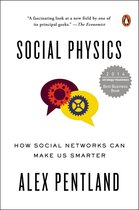
Social Physics How Social Networks Can Make Us Smarter
Vraag het Shophulp, de AI-assistent van bol
Samenvatting
From one of the world's leading data scientists, a landmark tour of the new science of idea flow, offering revolutionary insights into the mysteries of collective intelligence and social influence If the Big Data revolution has a presiding genius, it is MIT's Alex Sandy Pentland. Over years of groundbreaking experiments, he has distilled remarkable discoveries significant enough to become the bedrock of a whole new scientific field: social physics. Humans have more in common with bees than we like to admit: We're social creatures first and foremost. Our most important habits of action-and most basic notions of common sense-are wired into us through our coordination in social groups. Social physics is about idea flow, the way human social networks spread ideas and transform those ideas into behaviors. Thanks to the millions of digital bread crumbs people leave behind via smartphones, GPS devices, and the Internet, the amount of new information we have about human activity is truly profound. Until now, sociologists have depended on limited data sets and surveys that tell us how people say they think and behave, rather than what they actually do. As a result, we've been stuck with the same stale social structures-classes, markets-and a focus on individual actors, data snapshots, and steady states. Pentland shows that, in fact, humans respond much more powerfully to social incentives that involve rewarding others and strengthening the ties that bind than incentives that involve only their own economic self-interest. Pentland and his teams have found that they can study patterns of information exchange in a social network without any knowledge of the actual content of the information and predict with stunning accuracy how productive and effective that network is, whether it's a business or an entire city. We can maximize a group's collective intelligence to improve performance and use social incentives to create new organizations and guide them through disruptive change in a way that maximizes the good. At every level of interaction, from small groups to large cities, social networks can be tuned to increase exploration and engagement, thus vastly improving idea flow. Social Physics will change the way we think about how we learn and how our social groups work-and can be made to work better, at every level of society. Pentland leads readers to the edge of the most important revolution in the study of social behavior in a generation, an entirely new way to look at life itself.
Productspecificaties
Inhoud
- Taal
- en
- Uitvoering
- Paperback
- Oorspronkelijke releasedatum
- 27 januari 2015
- Aantal pagina's
- 300
- Illustraties
- Nee
Betrokkenen
- Hoofdauteur
- Hoofduitgeverij
Informatie over de fabrikant
- Fabrikant Naam
- Penguin Random House Ireland
- Fabrikant Adres
- Morrison Chambers, 32 Nassau Street - D02 YH68 - Dublin - IE
- E-mailadres of online contactformulier van de fabrikant
- gpsr@libri.de
Overige kenmerken
- Extra groot lettertype
- Nee
- Porno
- Nee
- Primaire Productiemaatschappij
- Penguin Books
- Product breedte
- 135 mm
- Product hoogte
- 17 mm
- Product lengte
- 204 mm
- Studieboek
- Nee
- Verpakking breedte
- 134 mm
- Verpakking hoogte
- 22 mm
- Verpakking lengte
- 205 mm
- Verpakkingsgewicht
- 245 g
EAN
- EAN
- 9780143126331
Productveiligheid
De verantwoordelijk marktdeelnemer in de EU zorgt voor het nakomen van verplichtingen op het gebied van productveiligheid.
Je vindt dit artikel in
- Categorieën
- Boek, ebook of luisterboek?
- Beschikbaarheid
- Taal
- Type boek
Documenten
Reviews
Nog geen reviews
Kies gewenste uitvoering
Kies je uitvoering
Verwacht over 4 weken
Gratis verzending door bol vanaf 25 euro
Ophalen bij een bol afhaalpunt mogelijk
30 dagen bedenktijd en gratis retourneren via mijn bol
Dag en nacht klantenservice
Doordeweeks ook ’s avonds in huis
Bekijk ook eens






Anderen bekeken ook
Bekijk de hele lijst