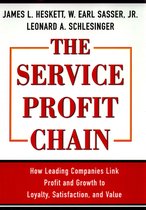
Service Profit Chain How Leading Companies Link Profit and Growth to Loyalty, Satisfaction, and Value
Co-auteur:
Uitgever:
EngelsHardcover978068483256210 april 1997301 pagina's
Samenvatting
This work provides a model that service-firm managers should be able to implement. It directly links profit and growth to employee productivity, loyalty and satisfaction, and the authors lay out a step-by-step action plan for managing, marketing, hiring, delivering services, and assessing faults.
In this pathbreaking book, world-renowned Harvard Business School service firm experts James L. Heskett, W. Earl Sasser, Jr. and Leonard A. Schlesinger reveal that leading companies stay on top by managing the service profit chain.
Why are a select few service firms better at what they do -- year in and year out -- than their competitors? For most senior managers, the profusion of anecdotal "service excellence" books fails to address this key question. Based on five years of painstaking research, the authors show how managers at American Express, Southwest Airlines, Banc One, Waste Management, USAA, MBNA, Intuit, British Airways, Taco Bell, Fairfield Inns, Ritz-Carlton Hotel, and the Merry Maids subsidiary of ServiceMaster employ a quantifiable set of relationships that directly links profit and growth to not only customer loyalty and satisfaction, but to employee loyalty, satisfaction, and productivity. The strongest relationships the authors discovered are those between (1) profit and customer loyalty; (2) employee loyalty and customer loyalty; and (3) employee satisfaction and customer satisfaction. Moreover, these relationships are mutually reinforcing; that is, satisfied customers contribute to employee satisfaction and vice versa.
Here, finally, is the foundation for a powerful strategic service vision, a model on which any manager can build more focused operations and marketing capabilities. For example, the authors demonstrate how, in Banc One's operating divisions, a direct relationship between customer loyalty measured by the "depth" of a relationship, the number of banking services a customer utilizes, and profitability led the bank to encourage existing customers to further extend the bank services they use. Taco Bell has found that their stores in the top quadrant of customer satisfaction ratings outperform their other stores on all measures. At American Express Travel Services, offices that ticket quickly and accurately are more profitable than those which don't. With hundreds of examples like these, the authors show how to manage the customer-employee "satisfaction mirror" and the customer value equation to achieve a "customer's eye view" of goods and services. They describe how companies in any service industry can (1) measure service profit chain relationships across operating units; (2) communicate the resulting self-appraisal; (3) develop a "balanced scorecard" of performance; (4) develop a recognitions and rewards system tied to established measures; (5) communicate results company-wide; (6) develop an internal "best practice" information exchange; and (7) improve overall service profit chain performance.
What difference can service profit chain management make? A lot. Between 1986 and 1995, the common stock prices of the companies studied by the authors increased 147%, nearly twice as fast as the price of the stocks of their closest competitors. The proven success and high-yielding results from these high-achieving companies will make The Service Profit Chain required reading for senior, division, and business unit managers in all service companies, as well as for students of service management.
Productspecificaties
Inhoud
- Taal
- en
- Uitvoering
- Hardcover
- Oorspronkelijke releasedatum
- 10 april 1997
- Aantal pagina's
- 301
- Illustraties
- Met illustraties
Betrokkenen
- Hoofdauteur
- Tweede Auteur
- Co Auteur
- Hoofduitgeverij
Informatie over de fabrikant
- Fabrikant Naam
- Libri GmbH
- E-mailadres of online contactformulier van de fabrikant
- gpsr@libri.de
- Fabrikantgegevens
- De overige informatie van de fabrikant is momenteel niet beschikbaar.
Overige kenmerken
- Extra groot lettertype
- Nee
- Porno
- Nee
- Product breedte
- 160 mm
- Product hoogte
- 25 mm
- Product lengte
- 240 mm
- Studieboek
- Ja
- Verpakking breedte
- 163 mm
- Verpakking hoogte
- 30 mm
- Verpakking lengte
- 231 mm
- Verpakkingsgewicht
- 940 g
EAN
- EAN
- 9780684832562
Productveiligheid
De verantwoordelijk marktdeelnemer in de EU zorgt voor het nakomen van verplichtingen op het gebied van productveiligheid.
Je vindt dit artikel in
- Boek, ebook of luisterboek?
- Taal
- Type boek
- Over welke sector
Documenten
Reviews
Nog geen reviews
Kies gewenste uitvoering
Kies je uitvoering
Conditie: Goed
Op voorraad
Voor 15:00 uur besteld, morgen in huis
Bestellen en betalen via bol
Prijs inclusief verzendkosten, verstuurd door BoekenBalie NL
30 dagen bedenktijd en gratis retourneren via mijn bol
Anderen bekeken ook
The Value Profit Chain
Outlet