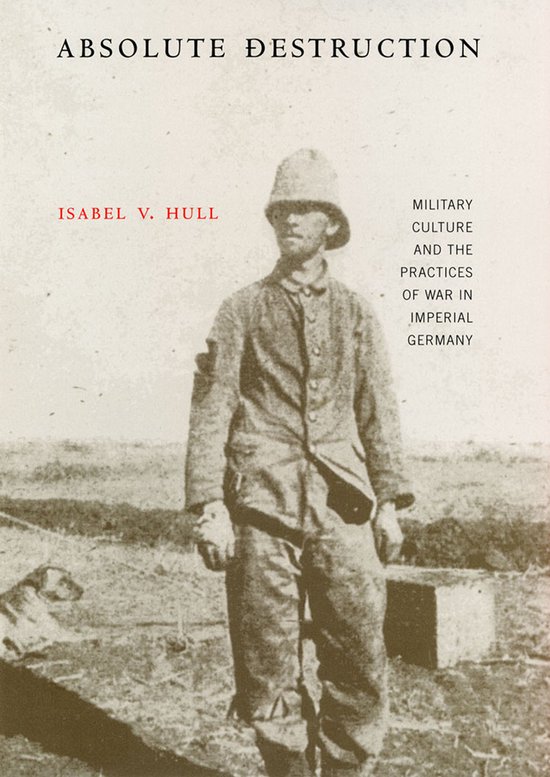
Absolute Destruction Military Culture And the Practices of War in Imperial Germany

Isabel V. Hull

Taal: Engels

EngelsPaperback978080147293015 februari 2006400 pagina's

Samenvatting

Hull argues that the routines and practices of the Imperial German Army, unchecked by effective civilian institutions, increasingly sought the absolute destruction of its enemies as the only guarantee of the nation's security.


In a book that is at once a major contribution to modern European history and a cautionary tale for today, Isabel V. Hull argues that the routines and practices of the Imperial German Army, unchecked by effective civilian institutions, increasingly sought the absolute destruction of its enemies as the only guarantee of the nation's security. So deeply embedded were the assumptions and procedures of this distinctively German military culture that the Army, in its drive to annihilate the enemy military, did not shrink from the utter destruction of civilian property and lives. Carried to its extreme, the logic of "military necessity" found real security only in extremities of destruction, in the "silence of the graveyard."Hull begins with a dramatic account, based on fresh archival work, of the German Army's slide from administrative murder to genocide in German Southwest Africa (1904–7). The author then moves back to 1870 and the war that inaugurated the Imperial era in German history, and analyzes the genesis and nature of this specifically German military culture and its operations in colonial warfare. In the First World War the routines perfected in the colonies were visited upon European populations. Hull focuses on one set of cases (Belgium and northern France) in which the transition to total destruction was checked (if barely) and on another (Armenia) in which "military necessity" caused Germany to accept its ally's genocidal policies even after these became militarily counterproductive. She then turns to the Endkampf (1918), the German General Staff's plan to achieve victory in the Great War even if the homeland were destroyed in the process—a seemingly insane campaign that completes the logic of this deeply institutionalized set of military routines and practices. Hull concludes by speculating on the role of this distinctive military culture in National Socialism's military and racial policies.Absolute Destruction has serious implications for the nature of warmaking in any modern power. At its heart is a warning about the blindness of bureaucratic routines, especially when those bureaucracies command the instruments of mass death.

Productspecificaties

Inhoud

Taal
en
Uitvoering
Paperback
Oorspronkelijke releasedatum
15 februari 2006
Aantal pagina's
400
Illustraties
Nee

Vertaling

Originele titel
Absolute Destruction: Military Culture and the Practices of War in Imperial Germany

Informatie over de fabrikant

Fabrikantgegevens
De informatie van de fabrikant is momenteel niet beschikbaar.

Overige kenmerken

Editie
New ed
Extra groot lettertype
Nee
Porno
Nee
Product breedte
167 mm
Product hoogte
32 mm
Product lengte
238 mm
Studieboek
Ja
Verpakking breedte
169 mm
Verpakking hoogte
27 mm
Verpakking lengte
235 mm
Verpakkingsgewicht
892 g

EAN

EAN
9780801472930

Productveiligheid

Verantwoordelijk marktdeelnemer in de EU

Je vindt dit artikel in

Reviews

Nog geen reviews

Kies gewenste uitvoering

Kies je uitvoering
Prijsinformatie en bestellenDe prijs van dit product is 26 euro en 99 cent.
Uiterlijk 24 april in huis
Verkoop door bol
  • Prijs inclusief verzendkosten, verstuurd door bol

  • Ophalen bij een bol afhaalpunt mogelijk

  • 30 dagen bedenktijd en gratis retourneren

  • Wettelijke garantie via bol

  • Dag en nacht klantenservice

Bekijk retourvoorwaarden

Bekijk ook eens

Drie oorlogen

Poetins tsaristische droom

Land van valse beloften

De Hanze

Heksenjacht

Anderen bekeken ook

Bekijk de hele lijst

Vaak samen gekocht

Crashed

Verkoop door
bol

Blood and Ruins

Verkoop door
bol

Pursuit of Power

Verkoop door
bol

The Deluge

Verkoop door
bol

The Deluge

Verkoop door
bol
Bekijk de hele lijst