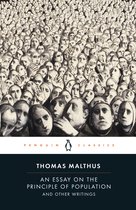
An Essay on the Principle of Population
Auteur:
Uitgever:
Illustrator:
EngelsPaperback978046419411813 augustus 2019160 pagina's
Thomas Malthus
THOMAS MALTHUS gratuated from Cambridge and settled in Hertfordshire as a lecturer in history and political economy at the East India Company College. Among his many works,
An Essay on the Principle of Population was the most sucessful and most outrageous. He boldly opposed popular Enlightenment ideals of the 18th-century.
Alles van Thomas MalthusSamenvatting
The book An Essay on the Principle of Population was first published anonymously in 1798,[1] but the author was soon identified as Thomas Robert Malthus. The book predicted a grim future, as population would increase geometrically, doubling every 25 years,[2] but food production would only grow arithmetically, which would result in famine and starvation, unless births were controlled.While it was not the first book on population, it was revised for over 28 years and has been acknowledged as the most influential work of its era. Malthus's book fuelled debate about the size of the population in the Kingdom of Great Britain and contributed to the passing of the Census Act 1800. This Act enabled the holding of a national census in England, Wales and Scotland, starting in 1801 and continuing every ten years to the present. The book's 6th edition (1826) was independently cited as a key influence by both Charles Darwin and Alfred Russel Wallace in developing the theory of natural selection. A key portion of the book was dedicated to what is now known as Malthus' Iron Law of Population. This name itself is retrospective, based on the iron law of wages, which is the reformulation of Malthus' position by Ferdinand Lassalle, who in turn derived the name from Goethe's "great, eternal iron laws" in Das Göttliche.[3] This theory suggested that growing population rates would contribute to a rising supply of labour that would inevitably lower wages. In essence, Malthus feared that continued population growth would lend itself to poverty and famine.
Productspecificaties
Inhoud
- Taal
- en
- Uitvoering
- Paperback
- Oorspronkelijke releasedatum
- 13 augustus 2019
- Aantal pagina's
- 160
- Illustraties
- Nee
Betrokkenen
- Hoofdauteur
- Tweede Auteur
- Hoofdillustrator
- Tweede Illustrator
- Hoofdredacteur
- Hoofduitgeverij
Informatie over de fabrikant
- Fabrikant Naam
- Libri GmbH
- E-mailadres of online contactformulier van de fabrikant
- gpsr@libri.de
- Fabrikantgegevens
- De overige informatie van de fabrikant is momenteel niet beschikbaar.
Overige kenmerken
- Extra groot lettertype
- Nee
- Porno
- Nee
- Product breedte
- 152 mm
- Product hoogte
- 9 mm
- Product lengte
- 229 mm
- Studieboek
- Ja
- Verpakking breedte
- 152 mm
- Verpakking hoogte
- 9 mm
- Verpakking lengte
- 229 mm
- Verpakkingsgewicht
- 222 g
EAN
- EAN
- 9780464194118
Productveiligheid
De verantwoordelijk marktdeelnemer in de EU zorgt voor het nakomen van verplichtingen op het gebied van productveiligheid.
Je vindt dit artikel in
- Categorieën
- Boek, ebook of luisterboek?
- Beschikbaarheid
- Taal
- Periode
Documenten
Reviews
Select-leden verdienen punten met hun reviews
10 oktober 201720-29 jaarGentHeeft dit artikel gekochtAugustus123
Geschreven bij: An Essay on the Principle of Population
- Overzichtelijk
In één woord: Overzichtelijk
Kies gewenste uitvoering
Kies je uitvoering
Uiterlijk 20 oktober in huis
Gratis verzending door bol vanaf 25 euro
Ophalen bij een bol afhaalpunt mogelijk
30 dagen bedenktijd en gratis retourneren via mijn bol
Dag en nacht klantenservice
Bekijk ook eens




Anderen bekeken ook
Bekijk de hele lijst





Alle uitvoeringen (17)
E-book
2022
Direct beschikbaar
E-book
2019
Direct beschikbaar
E-book
2018
Direct beschikbaar
E-book
2015
Direct beschikbaar
E-book
2012
Direct beschikbaar
E-book
2009
Direct beschikbaar
E-book
1999
Direct beschikbaar
Paperback
2019
Uiterlijk 20 oktober in huis
Paperback
2016
Verwacht over 4 weken
Paperback
2016
Verwacht over 4 weken
Paperback
2015
Verwacht over 4 weken
Paperback
2008
Uiterlijk 16 oktober in huisPaperback
Verwacht over 4 weken
Hardcover
2022
Uiterlijk 20 oktober in huis
Hardcover
2018
Verwacht over 4 wekenHardcover
Verwacht over 4 weken
Hardcover
Verwacht over 4 weken