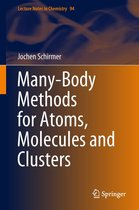
Lecture Notes in Chemistry94- Many-Body Methods for Atoms, Molecules and Clusters
Vraag het Shophulp, de AI-assistent van bol
Auteur:
Uitgever:
EngelsHardcover978331993601703 november 2018332 pagina's
Samenvatting
This book provides an introduction to many-body methods for applications in quantum chemistry. Offering an introduction to many-body methods, this book appeals to advanced students interested in an alternative approach to the many-electron problem in molecules, and is suitable for any courses dealing with computational methods in quantum chemistry.
This book provides an introduction to many-body methods for applications in quantum chemistry. These methods, originating in field-theory, offer an alternative to conventional quantum-chemical approaches to the treatment of the many-electron problem in molecules. Starting with a general introduction to the atomic and molecular many-electron problem, the book then develops a stringent formalism of field-theoretical many-body theory, culminating in the diagrammatic perturbation expansions of many-body Green's functions or propagators in terms of Feynman diagrams. It also introduces and analyzes practical computational methods, such as the field-tested algebraic-diagrammatic construction (ADC) schemes. The ADC concept can also be established via a wave-function based procedure, referred to as intermediate state representation (ISR), which bridges the gap between propagator and wave-function formulations. Based on the current rapid increase in computer power and the developmentof efficient computational methods, quantum chemistry has emerged as a potent theoretical tool for treating ever-larger molecules and problems of chemical and physical interest. Offering an introduction to many-body methods, this book appeals to advanced students interested in an alternative approach to the many-electron problem in molecules, and is suitable for any courses dealing with computational methods in quantum chemistry.
This book provides an introduction to many-body methods for applications in quantum chemistry. These methods, originating in field-theory, offer an alternative to conventional quantum-chemical approaches to the treatment of the many-electron problem in molecules. Starting with a general introduction to the atomic and molecular many-electron problem, the book then develops a stringent formalism of field-theoretical many-body theory, culminating in the diagrammatic perturbation expansions of many-body Green's functions or propagators in terms of Feynman diagrams. It also introduces and analyzes practical computational methods, such as the field-tested algebraic-diagrammatic construction (ADC) schemes. The ADC concept can also be established via a wave-function based procedure, referred to as intermediate state representation (ISR), which bridges the gap between propagator and wave-function formulations. Based on the current rapid increase in computer power and the development of efficient computational methods, quantum chemistry has emerged as a potent theoretical tool for treating ever-larger molecules and problems of chemical and physical interest. Offering an introduction to many-body methods, this book appeals to advanced students interested in an alternative approach to the many-electron problem in molecules, and is suitable for any courses dealing with computational methods in quantum chemistry.
Productspecificaties
Inhoud
- Taal
- en
- Uitvoering
- Hardcover
- Oorspronkelijke releasedatum
- 03 november 2018
- Aantal pagina's
- 332
- Illustraties
- Met illustraties
Betrokkenen
- Hoofdauteur
- Hoofduitgeverij
Informatie over de fabrikant
- Fabrikant Naam
- Springer Nature Customer Service Center Gmbh
- Fabrikant Adres
- Europaplatz 3 | 69115| Heidelberg| DE
- E-mailadres of online contactformulier van de fabrikant
- ProductSafety@springernature.com
Overige kenmerken
- AI-gegenereerd
- Nee
- Editie
- 1
- Extra groot lettertype
- Nee
- Product breedte
- 155 mm
- Product lengte
- 235 mm
- Studieboek
- Nee
- Verpakking breedte
- 155 mm
- Verpakking hoogte
- 20 mm
- Verpakking lengte
- 235 mm
- Verpakkingsgewicht
- 823 g
EAN
- EAN
- 9783319936017
Productveiligheid
De verantwoordelijk marktdeelnemer in de EU zorgt voor het nakomen van verplichtingen op het gebied van productveiligheid.
Je vindt dit artikel in
- Categorieën
- Boek, ebook of luisterboek?
- Beschikbaarheid
- Taal
- Type boek
Documenten
Reviews
Nog geen reviews
Kies gewenste uitvoering
Kies je uitvoering
Verwacht over 3 weken
Prijs inclusief verzendkosten, verstuurd door bol
Ophalen bij een bol afhaalpunt mogelijk
30 dagen bedenktijd en gratis retourneren via mijn bol
Dag en nacht klantenservice
Doordeweeks ook ’s avonds in huis